Edward Jackson was found dead inside a barrel at Lake Mead after more than 40 years. His identity is known, but his killer remains a mystery.
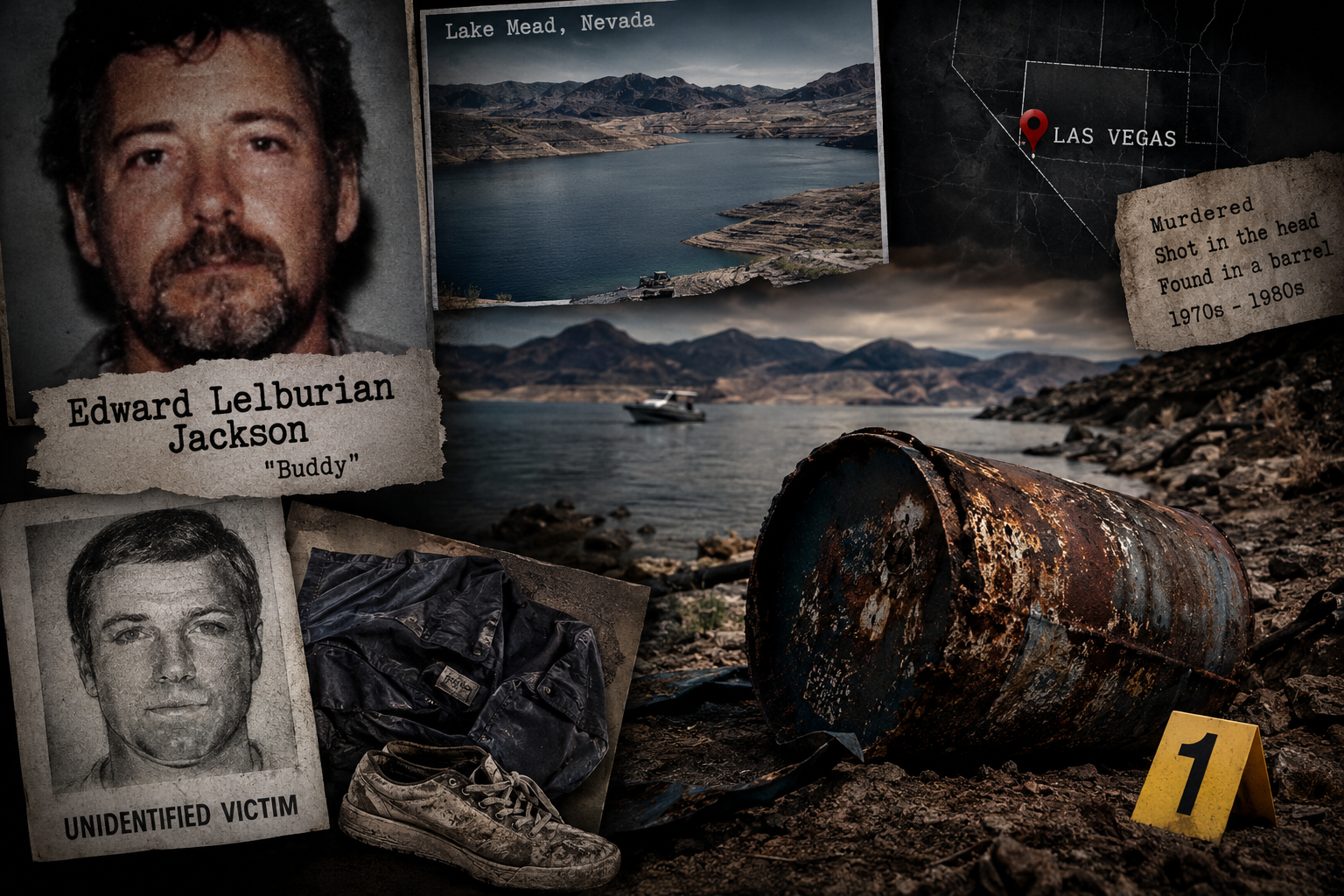
On a shrinking shoreline near Las Vegas, a rusted barrel appeared where nobody expected to find one.
It was May 1, 2022.
Boaters near Hemenway Harbor noticed the barrel in an area that had once been covered by Lake Mead. What looked like an abandoned container turned out to be something far more disturbing.
There were human remains inside.
The man had been dead for decades.
Investigators soon determined that he had been shot in the head and that his death was a homicide.
But there was a problem.
They had a murder victim with no identity.
For more than four years, investigators knew how the man died without knowing who he was.
That changed in October 2026.
Authorities announced that the remains belonged to Edward Lelburian Jackson, also known as “Buddy,” an Arkansas man who was in his mid-to-late 50s when he died.
His identity had finally been recovered.
His killer had not.
And that may be where the real mystery begins.
A Body Where the Water Used to Be
Lake Mead had been changing for years before the barrel appeared.
Long-term drought, water shortages, heavy use of the Colorado River system and rising temperatures had pushed the reservoir to historically low levels. As the water retreated, sections of shoreline that had been underwater for decades became exposed.
That changing landscape revealed the barrel.
Investigators determined that the victim had probably been killed sometime around the late 1970s or early 1980s. His clothing and shoes helped establish the approximate period of his death.
In other words, the barrel had apparently remained hidden for roughly four decades.
Whoever put Jackson inside it had succeeded in keeping the body out of sight for an extraordinary length of time.
Then the lake began giving up what it had concealed.
The Man Behind the Mystery
The victim was not an unknown man with no history.
Edward Lelburian Jackson was from Hot Springs, Arkansas.
At different points in his life, he had lived in other parts of the country, including California and Utah. He had also been married for a period of time and had no known children.
His relatives remembered something else about him.
Jackson traveled.
He could disappear for periods of time and later turn up again.
That detail became significant after his death.
His family last remembered seeing him in Arkansas in the early 1980s.
Then contact stopped.
There was no missing-person investigation carrying his name through the following decades.
His family had no reason to imagine that he had already been murdered.
The Investigation Had a Face, But No Name
Investigators had Jackson’s remains.
They also had DNA.
But having DNA is not the same as knowing whose DNA it is.
Authorities created composite images showing what the unidentified victim may have looked like. The images were released publicly in an attempt to generate information.
Investigators also documented the clothing and shoes found with the remains and entered the information into databases used to identify missing and unidentified people.
Still, the identity remained out of reach.
Then the investigation took a different path.
The DNA Clue That Changed Everything
In 2024, investigators sent a bone sample for genetic genealogy profiling.
The first potential lead was not strong enough to establish an identification.
The case could have remained frozen there.
Instead, the forensic investigation continued.
Researchers at Oklahoma State University’s forensic science program became involved. They worked with the victim’s DNA profile and genealogy information to search for biological relatives.
The process was not as simple as matching one name to one database.
Researchers followed possible family connections on both sides of Jackson’s family.
A social media post concerning Jackson’s disappearance also provided another clue.
Investigators eventually obtained DNA from Jackson’s relatives.
The comparison produced a compelling match.
The unidentified man in the barrel was Edward Lelburian Jackson.
After more than four decades, the victim finally had a name.
But the discovery created a strange situation.
The investigators had solved the mystery of who the dead man was.
They had not solved the mystery of who killed him.
What Was Edward Jackson Doing Near Las Vegas?
This may be the most important unanswered question.
Investigators have not established a known connection between Jackson and Las Vegas.
His family knew he traveled, but they did not know why he was in Nevada.
There is no confirmed explanation for how he got there, who he was meeting, or what he was doing shortly before his death.
That leaves several possibilities.
Perhaps he was simply traveling.
Perhaps he had gone to Las Vegas to meet someone.
Perhaps he was involved in a business or financial dispute.
Perhaps he had connections there that his family never knew about.
Or perhaps his presence in Nevada had nothing to do with the reason he was killed.
At this stage, none of these explanations has been established as fact.
One Part of His Past Is Worth Examining
Jackson’s life also contained a criminal record.
During the early 1980s, while in Salt Lake City, Utah, he had a criminal history that included an aggravated arson charge and conspiracy to commit fraud.
That information is interesting.
But it is not an answer.
A criminal record does not prove that someone was involved in organized crime, nor does it establish a connection between that past and his murder.
It simply gives investigators another part of Jackson’s history to examine.
Someone who knew him during that period might know something that has never been connected to the case.
Was It a Mob Killing?
This is the theory that has attracted the most attention.
The timing is difficult to ignore.
Jackson is believed to have been killed around the late 1970s or early 1980s, when organized crime still had a significant historical presence in Las Vegas.
Then there is the barrel.
A murdered man placed inside a barrel is an image strongly associated with organized-crime killings of that era.
Some experts have pointed to similarities between the circumstances and other killings from the mob era.
But there is a major problem with that theory.
There is no direct evidence connecting Jackson’s murder to organized crime.
Las Vegas police have said they have found nothing establishing such a connection, although they have not ruled it out.
That distinction is crucial.
The circumstances may resemble a mob killing.
That does not mean it was one.
Until investigators uncover evidence linking Jackson to a specific criminal organization, the mob theory remains an intriguing possibility rather than an established explanation.
The Barrel May Not Tell Us Where He Was Killed
There is another possibility that deserves attention.
The place where a body is discovered is not necessarily the place where the murder happened.
Jackson could have been killed somewhere else.
His body could then have been placed inside the barrel and transported to Lake Mead.
If that happened, investigators would be dealing with two separate locations:
the original crime scene,
and the location chosen to hide the body.
That distinction could be extremely important.
If the original crime scene was somewhere else, evidence from the actual shooting may have disappeared decades ago.
Buildings may have been demolished.
Vehicles may have disappeared.
Records may no longer exist.
Witnesses may have died.
And memories that once seemed unimportant may have faded completely.
The lake may have hidden the body.
But it may also have hidden the answer to where the crime actually occurred.
Why Didn’t Anyone Report Jackson Missing?
This may be the most tragic detail in the entire investigation.
Jackson had a lifestyle that made long periods away from home seem normal to the people who knew him.
His relatives expected him to travel.
So when he stopped appearing, they did not immediately think that he had been murdered.
That meant there was no urgent search for a missing man whose name could have been compared with unidentified remains.
Instead, authorities discovered a dead man whose identity had effectively disappeared with him.
For decades, Jackson was not the subject of a missing-person case.
He was simply an unidentified homicide victim.
And that may have cost investigators years.
The Water Was Falling. The Mystery Was Rising.
The discovery of Jackson’s remains was directly connected to the changing condition of Lake Mead.
As the reservoir fell, areas that had been underwater for years became exposed.
The shoreline moved.
Objects hidden beneath the water began to appear.
And eventually, the barrel emerged.
The discovery did not solve the murder.
It simply made the murder visible again.
Lake Mead has produced other human remains as water levels have fallen, although those cases have involved different circumstances, including drownings and accidents.
Jackson’s case is different because investigators determined that he had been shot in the head.
His death was not simply another consequence of the lake’s changing shoreline.
It was a homicide.
Someone caused it.
What We Know
After more than four decades, investigators can now establish several important facts:
- The victim was Edward Lelburian “Buddy” Jackson.
- He was originally from Hot Springs, Arkansas.
- He had lived in California and Utah.
- He was in his mid-to-late 50s when he died.
- He suffered a gunshot wound to the head.
- His remains were discovered inside a rusted barrel near Hemenway Harbor on May 1, 2022.
- Investigators believe he died around the late 1970s or early 1980s.
- His family last remembered seeing him in Arkansas around the early 1980s.
- He had not been reported missing.
- His identity was established through forensic genetic genealogy and DNA testing with relatives.
- The homicide investigation remains open.
What Remains Unknown
And then there is the part that makes this a genuine cold case.
Investigators still need to determine:
- Who shot Jackson?
- Where was he actually killed?
- Who put him inside the barrel?
- Who transported the barrel to Lake Mead?
- Why was Jackson in the Las Vegas area?
- Who was he meeting, if anyone?
- Did his criminal history have anything to do with his death?
- Did he know the person who killed him?
- Was organized crime involved?
- Why did someone believe the body would never be discovered?
None of these questions has a confirmed answer yet.
The Identity Was Only the First Door
For years, investigators were trying to solve one basic question:
Who was the man in the barrel?
Now they know.
But a name changes the investigation.
Jackson is no longer an unidentified set of remains.
Investigators can now reconstruct his life.
They can look at where he lived.
Who he knew.
Where he traveled.
Who he had contact with.
What happened during the final months of his life.
And perhaps most importantly, they can return to the people who knew him and ask questions that were impossible to ask when the victim had no name.
A cold case that once began with a nameless body now has a person at its center.
That could lead investigators somewhere the barrel never could.
Someone Put Him There
The most disturbing part of the case is also the simplest.
Jackson did not end up inside that barrel by accident.
Someone put him there.
Someone had access to his body after he was shot.
Someone decided that hiding him was better than leaving him where he could be found.
And for more than forty years, that decision worked.
The lake concealed the evidence.
Time weakened the trail.
And Jackson’s own family did not know they were waiting for a man who would never return.
Then the water dropped.
The barrel emerged.
A forgotten murder became visible again.
Four years after the discovery, science finally restored the victim’s identity.
But the person responsible remains unknown.
The lake gave investigators the body.
Forensic genealogy gave them the name.
Now the question is whether someone, somewhere, still remembers what happened to Edward “Buddy” Jackson.
Because after more than forty years, the mystery is no longer about finding the man in the barrel.
It is about finding the person who put him there.
The mystery surrounding Edward Jackson is a reminder that some of the darkest criminal cases can remain unanswered for decades. In another case involving the shadowy world of organized crime, the story of Ridouan Taghi, the Dutch crime boss, offers a very different look at how criminal networks, violence and unanswered questions can become intertwined.